Daintree Rainforest: The World’s Immortal Hotspot
There are places on Earth that exist in time.
And then there are places that exist outside of it.
The Daintree Rainforest is not just a forest — it is a survivor.
While continents shifted, species vanished, ice ages came and went, and dinosaurs ruled and fell, this forest never left.

For over 180 million years, Daintree has remained alive — adapting, reshaping, and quietly watching the rest of the world change.
This is not a story of trees and animals.
This is the story of Earth’s memory — still breathing.
A Forest Older Than Dinosaurs
To understand why Daintree is called immortal, you have to understand its age.
Daintree began forming long before dinosaurs ever walked the planet. When the first dinosaurs appeared around 230 million years ago, this forest was already ancient. While dinosaurs dominated the land, Daintree evolved alongside them, not after them.
Most rainforests we see today are young in geological terms.
Daintree is not.
Many of its plant species belong to primitive plant families that existed when Earth’s ecosystems were still experimental. Some flowering plants here are direct descendants of the earliest flowering plants on the planet.
In simple words:
Daintree is not a modern forest.
It is a living fossil ecosystem.
What the Prehistoric Daintree Looked Like
Imagine the Daintree during the prehistoric era.
The air was thicker.
The forest floor darker.
The canopy almost completely blocked sunlight.
This was not a place of beauty — it was a place of dominance.
Huge ferns, ancient cycads, towering conifers, and early flowering plants formed layers upon layers of vegetation. The density was so extreme that moving through the forest would have felt like pushing through a living wall.
This environment favored giants.
Not fast runners.
Not fragile flyers.
But powerful, patient creatures built to survive in shadows.
When Giants Ruled Australia
Australia was once home to some of the largest and strangest creatures Earth has ever produced — and the rainforests of the north played a crucial role in sustaining them.
A giant wombat-like creature, as large as a rhinoceros. It roamed forests and open lands, feeding on massive quantities of vegetation.
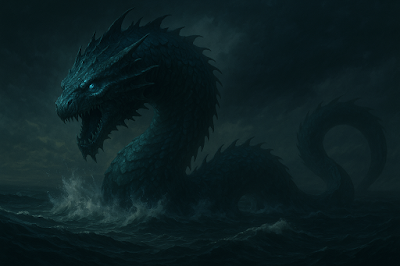
A real-life dragon — a giant monitor lizard stretching up to 7 meters. In dense forest zones, ambush was its weapon.
Thylacoleo (Marsupial Lion)
One of the most powerful mammalian predators ever known. Its bite force was unmatched for its size, and it likely used forest cover to hunt.
These creatures were not myths.
They were products of isolation.
Australia broke away from other continents millions of years ago, allowing evolution to follow different rules. Daintree was one of the ecosystems where those rules produced giants.
The Crocodile Kingdom
If one creature truly still rules the Daintree, it is the saltwater crocodile.
The Daintree River is one of the most crocodile-dense regions in the world. These reptiles are not just survivors — they are ancient perfection.
Saltwater crocodiles have remained almost unchanged for over 200 million years. They existed before dinosaurs and outlived them.
In the Daintree:
• Crocodiles control river systems
• They regulate prey populations
• They shape aquatic behavior of other species
This is not coexistence.
This is dominion.
The water here is never neutral. Every ripple carries the memory of a predator that does not need to evolve anymore.
A Forest of Extreme Density
Daintree is one of the densest rainforests on Earth.
In some areas:
More than 30 species of trees can exist in a single hectare
Multiple canopy layers trap moisture and heat
Light struggles to reach the forest floor

This density creates micro-worlds:
★One layer for insects
★One for reptiles
★One for birds
★One for mammals
Life here is stacked vertically.
This density is also the reason why Daintree could protect ancient species while the rest of the world changed.
Not Just Land — A Deadly Aquatic World
Daintree’s danger doesn’t end at land.
Its rivers, creeks, and wetlands host:
Crocodiles
Amphibians with prehistoric traits
Freshwater here blends into mangroves, and mangroves blend into the sea — creating one of the most complex aquatic-terrestrial transitions on Earth.
Few ecosystems in the world are this interconnected.
The Giants That Still Slither
Among the forest’s most mysterious inhabitants are giant snakes.
Australia has long hosted massive constrictors and venomous snakes adapted to dense habitats. While the legendary prehistoric snake Titanoboa lived elsewhere, Australia produced its own powerful serpents that dominated rainforest food chains.
In Daintree:
Snakes control rodent and amphibian populations
Some species rely on both land and water
Venom here evolved to be fast-acting and lethal
The forest favors precision, not chaos.
Species That Exist Nowhere Else
Daintree is a biodiversity vault.
Many species found here exist nowhere else on Earth:
Primitive insects with ancient lineages
Birds whose ancestors flew alongside dinosaurs
Plants that represent evolutionary dead ends elsewhere
Some plants here are so ancient that scientists consider them evolutionary bridges between extinct and modern species.
This makes Daintree not just rare — but irreplaceable.
Plants That Are Giants Too
The giants of Daintree are not only animals.
Massive strangler figs, ancient cycads, towering fan palms, and primitive flowering plants dominate the landscape. Some trees take centuries to mature.
These plants:
Control humidity
Create shade ecosystems
Shape animal evolution
Without these plant giants, the animal giants would never have existed.
The Dinosaur Connection
No dinosaurs live in Daintree today — but their world does.
Many plants in Daintree evolved specifically to survive large herbivores, including dinosaurs. Thick leaves, toxic chemicals, and rapid regrowth were survival strategies developed in a time when giant reptiles fed endlessly.
Bird species in Daintree are also descendants of avian dinosaurs, making the forest a place where dinosaur lineage still breathes.
Daintree did not forget the dinosaurs.
It absorbed them.
Why Daintree Refuses to Die
Every mass extinction wiped out ecosystems worldwide.
Daintree survived because:
It remained climatically stable
It adapted instead of resisting change
It existed in isolation
While other ecosystems collapsed, Daintree reshaped itself.
That is why it is called immortal — not because nothing dies here, but because life never stops reorganizing.
A Living Warning — And a Promise
Daintree shows us something uncomfortable.
The world doesn’t need saving.
It needs space.
When nature is left alone, it doesn’t collapse — it outgrows us.
This forest is proof that Earth has already survived worse than humanity.
And it will survive us too.
Final Thought: The Immortal Hotspot
Daintree Rainforest is not just a destination.
It is a time capsule, a biological stronghold, and a reminder.
While civilizations rise and fall, while species appear and vanish, this forest stands — quiet, dense, watching.
•Not dying.
•Not ending.
•Just waiting.

.webp)
Comments
Post a Comment